Follow John & Gregg Capturing the Essence of Wow..
Showing posts with label Maienza-Wilson. Show all posts

Friday, April 9

Vintage Art from the South Pacific: Paul Jacoulet's Woodblock Prints


ShareThis

John and I had purchased our first home in Hawaii, on Royal Circle in 2004.  Shortly after we happened to be at an art fair in Honolulu when we came upon a lone woodblock print by Paul Jacoulet sitting on the floor of a vendors stall.  It spoke to both of us from its color and composition, and by the time we were leaving the fair, we decided we had to have it.  Turns out that a well known collector of art in Honolulu was also negotiating a deal on the same piece, at that very moment, so we had to act quickly.   We told the sellers, a local Hawaiian family, that the piece would never leave the islands, that it would remain in the Pacific as long as we owned it and that clenched the deal for them.  Today, it hangs in our home, its colors as radiant as they were when it was new, and is one of the most stunning pieces we own...it also matches our home in vintage and color!
 Above is an image of the piece we own.  A young boy from the East Carolinian island of Ponape and dates from 1930.   The vibrancy of this piece is as bold today as it was 80 years ago when it was painted.  We are lucky to have found it and as it is titled 'The call of the Sea', it called out to us!

Paul Jacoulet was a French born artist, (1902-1960) is little known in this day and age, but who was a remarkable portraitist during his time.  He was the son of the French Ambassador to Japan, and was raised in Japan since childhood, and studied art as a young native born Japanese boy would have.  His immersion into Japanese life as a young man, led him to live out World War II in a Japanese countryside as a farmer, rather than return to Europe or move elsewhere in the west.  He was a childhood friend of Isamu Noguchi, the internationally acclaimed artist, having been taught english by Noguchi's mother.  He did work for the US Government at the request of General Douglas MacArthur, but more intriguingly he became a part of MacArthur's own art collection, as well as a part of Greta Garbo's and Queen Elizabeth also has a large collection of his work.  His work has been shown in leading museums around the world for decades.
This piece, from the Marianas islands shows a native islander in an amazingly detailed costume color national dress.  Note the detail on the woven mat.

Jacoulet is also recognized as one of the few western artists to have mastered the art of woodblock printing sufficiently to be recognized as a sensei (master) in Japan.  He mastered the traditional ukiyo-e style of woodblock printing as well as enhancing those techniques into his own style.  His remarkable career spanned nearly 40 years, and his subject matter, the peoples of the asian world in traditional costume in everyday poses and circumstances.  He traveled widely throughout the sparsely populated Pacific in the 20s. 30s, and 40s, often capturing local islanders and costume in vibrant colors as only a multi-process woodblock print can.  Some of the Pacific Island nations have used Jacoulet's portraits to reconstruct the imagery of their native costumes from the period, as his is the only record of such.    

Jacoulet, incidentally, was a very 'out' gay man, in a time when it was neither popular nor acceptable.  He would frequently wear kimonos and kabuki makeup while at home or while entertaining dignitaries, collectors and friends.  He was barred from entering the US in his lifetime due to his flamboyance.  Times have changed, but one thing is clear, Jacoulet's genius of color and woodblock withstands the test of time!


Related Posts with Thumbnails

Thursday, April 8

2010 Heal the Ocean Event..Planning is Underway!


ShareThis


We are very excited to announce that we have been asked to Chair the 2010 Heal the Ocean Event Committee!  This years event will be held at the Coral Casino on October 9, 2010.  We have been brainstorming and have some exciting ideas and look forward to seeing all of you there!  We will keep you posted as to when tickets for this popular event will go on sale. 

Heal the Ocean in Santa Barbara is committed to ending ocean pollution by relying on the premise of studying the problems of leaking sewer pipes, offshore sewage discharge and leaking coastal landfills or septic systems and then recommending practical solutions instead of lobbying the government for action.  When the public is presented with answers to the problems and the costs are understood, they are more eager to move forward with the cleanup and more willing to pay the price. 

We are very excited to work with their team to put on a fundraiser that will help Heal the Ocean in our community!

Executive director, Hillary Hauser, has been a writer/ journalist/news reporter since 1968 with published books about sea and underwater exploration and many magazine articles published in many publications including National Geographic, Surfers Journal, Geo and Islands.


Related Posts with Thumbnails

Wednesday, April 7

The Debut of Solar Impulse a Solar Powered Plane!


ShareThis

"In a world depending on fossil energies, the Solar Impulse project is a paradox, almost a provocation: it aims to have an airplane take off and fly autonomously, day and night, propelled uniquely by solar energy, right round the world without fuel or pollution. An unachievable goal without pushing back the current technological limits in all fields..." 

Everything went perfectly as the Solar Impulse made it debut in the clouds this morning after seven years of hard work and planning.  The solar-powered plane powered by 12,000 solar cells flew for 87 minutes at an altitude of over 4,000 feet. It performed test maneuvers, taking off and landing.  The Solar Impulse is made out of carbon fiber concentrate and looks like a glider with a wingspan of 60 meters and is the largest and lightest plane ever to take flight.  
solar airplane,solar impulse,bertrand piccard,flight pioneer,carbon fiber plane,solar energy powered,solar cell plane,flight technology,flying,airplanes,geneva lunch,inhabitat,Best Technology,Aerial view,zero emission,Sustainable,sustainability,leading edge,green,environmental design,environmental issues,environmentally friendly,energy effecient lighting,Energy Consumption,eco-conscious,eco travel,Globally Gorgeous,green design,sustainable design materials,State of the Art,Maienza-Wilson

Swiss psychiatrist, Bertrand Piccard (below) was the first aeronaut to do a non stop flight around the world in a balloon.  He will soon be attempting the non stop flight around the world in a solar powered plane he helped design with co-founder Andre Borschberg, fighter pilot, engineer and graduate in management science.

“This first mission was the most risky phase of the entire project,” Piccard said.  “Eighty-seven minutes of intense emotion after seven years of research, testing and perseverance. Never has an airplane as large and light ever flown before!”
solar airplane,solar impulse,bertrand piccard,flight pioneer,carbon fiber plane,solar energy powered,solar cell plane,flight technology,flying,airplanes,geneva lunch,inhabitat,Best Technology,Aerial view,zero emission,Sustainable,sustainability,leading edge,green,environmental design,environmental issues,environmentally friendly,energy effecient lighting,Energy Consumption,eco-conscious,eco travel,Globally Gorgeous,green design,sustainable design materials,State of the Art,Maienza-Wilson
Here is what test pilot Marcus Scherdel had to say about the test flight in an interview with Martin Reichlin

Markus, you just completed the very first flight with the Solar Impulse. I suspect you feel like an Olympic champion now?
Well, I never was an Olympic champions yet. But I think the feeling is quite similar.

Could you enjoy this feeling already during the flight?
The first 20 minutes I had very little time for anything else than to do my job. After that I had gained enough altitude to have a look out of the window during my first turns and to enjoy the amazing panorama of the Alps.

Speaking of looking out the window: You were piloting something like an "aeronautic convertible" today as you had no shell around the cockpit. Wasn’t it pretty cold up there?

Not at all. I was wearing my special underwear and a windproof overall. In addition to that I got shoes and gloves with built-in heating. You see, we thought of everything.

But what about insects hitting your face as you had no windshield?
There were none. It’s still too cold for flies.

Probably the most critical part of the flight was the landing. Was it difficult for you?

Actually no. At that time I had already learned a lot about the plane and knew everything about its behavior I needed to know.

And how did it behave?
So far it was very well-tempered. But I have to say that today we were flying very slow – at one point the ground speed had dropped to 12 knots per hour (22 km/h) - and we never intended test the critical parameters of the plane. This will be one of the goals in the upcoming flights.


If you feel passionate about the program, join the challenge and experience it from the inside. Become an Angel Ambassador or Adviser.

See Also: The Cool Website for Solar Impuse
See Also: EAA website


Related Posts with Thumbnails

Sunday, April 4

An Eco Luxury, Net Zero & LEED Platinum Home Under Construction in Montecito, CA


ShareThis

Here is an update on the Eco Luxury House we are building at Butterfly Beach in Montecito, Ca. We collaborated with our friend and colleague Michelle Kaufman on the design of this home. Early on in the process we had intended this house to be a modular or prefab home because at that time we had the belief that this was the most proactive way for us to be as green as possible utilizing Michelle's five eco principles . This was not necessarily the case, and in the end we are actually building a custom home built on site that is as green or greener than our original prefab plan. In fact we are right on track to be the first LEED For Homes PLATINUM CERTIFIED home in Montecito and also hope to achieve and annual Net Zero Energy Equalibrium.  I know that Michelle is thrilled that we are determined to figure out how to make the most sustainable project as is possible now. It is the positive result of what turned into a somewhat unfortunate experience.
There is a sad tale with a happy ending that took us in our current direction. As many people know Michelle Kaufmann's company MKD Homes Closed it's doors in June of 2009.  We were slated to begin the prefabrication process of the original design for this house just as the factory and Michelle Kaufmann closed theirs doors. This was a terrible consequence of the poor economy last year. After we stopped reeling from this unfortunate news, we reorganized our process (at a cost of 4 months and substantial redesign expenditures) and became even more determined to build a sustainable home. In the end, we are building a very high end, high quality, custom, sustainable home. We are happy that Michelle reorganized is practicing architecture and design is still a champion of sustainable and even eco luxury design. Here's the new Michelle Kaufmann Studio.  Also, MKD Homes are now offered by  MKdesigns by blu homes which we think is fantastic that all of Michelle's intellectual collateral will continue on.  We wish Michelle and blu homes smooth sailing ahead!


Here's a Link to Our "Net Zero' Post
Here's a Link to Michelle Kaufmann's Blog Post aout this Eco Luxury House
See Also The New York Time: The Rise of 'Green' Modular Homes by Francesca Lyman

Related Posts with Thumbnails

Saturday, April 3

Easter Brunch Try a Little Bunny Food with Eggs: Baked Eggs with Spinach


ShareThis

This recipe....is one of those easy but sophisticated ones that can serve as a late morning breakfast, or brunch staple....baked eggs and spinach.

First, you blanch some spinach, dropping in boiling water for 30 seconds to a minute, and then lining a lightly greased oven safe bowl with about a half a cup of the spinach.

Break two eggs over the top of the spinach, and pop in the oven at 375 degrees (200 C) +/-, for about 15-20 minutes, or until the eggs are cooked to your liking.

The result is an almost quiche like consistency, that is tasty and there are no carbs.....it is also something that can be served at a table in the garden or at the kitchen counter, where traditional egg dishes can get cold quickly or are impractical....really simple and simply delicious!  Thanks again to Donna Hay!


Related Posts with Thumbnails

Tuesday, March 30

"WATER:OUR THIRSTY WORLD" PHOTOGRAPHY EXHIBIT


ShareThis

"WATER: OUR THIRSTY WORLD" ...An Exhibit at the Annenberg Space for Photography in Association with National Geographic Magazine opened Saturday, March 27, 2010.  This exhibition coincides with the release of National Geographic's April 2010 issue on the precarious state of the world's fresh water.  The exhibition will run through June 13, 2010 and examines the local and global challenges of our planet's fresh water resources captured by a selection of National Geographic's finest, award-winning photographers. The digital and print images will highlight the significance of fresh water in our lives and how the diminishment of this precious resource is impacting local and worldwide communities. A digital film presentation will expand the visitor experience by offering hundreds more National Geographic images and shared insights from photographers.
water blessing, conservation, national geographic, sacred water, john stanmeyer, joel sartore, silent streams, paolo pellegrin lynn johnson edward burtynsky, jonas bendiksen, the annenberg apace for photography, art, photography, globally gorgeous, maienza wilson,Art. Annenberg, fresh water, Globally Gorgeous, Maienza-Wilson, National Geographic, photography, Water Sustainability


Jonas Bendiksen, Magnum Photos
India, 2009
In a parched Delhi slum, men swarm a tanker to siphon precious water. “If you throw money here,” says a local 16-year-old named Vinay, “no one would have time to grab it. Water is more important for us.”
water blessing, conservation, national geographic, sacred water, john stanmeyer, joel sartore, silent streams, paolo pellegrin lynn johnson edward burtynsky, jonas bendiksen, the annenberg apace for photography, art, photography, globally gorgeous, maienza wilson,Art. Annenberg, fresh water, Globally Gorgeous, Maienza-Wilson, National Geographic, photography, Water Sustainability
Amit Dave, Reuters
India, 2003
Parched Indian villagers mob a vast well in Natwargadh, Gujarat. In this drought-prone western state, yearly monsoon rains can total less than eight inches, and summer temperatures have topped 115°F.

water blessing, conservation, national geographic, sacred water, john stanmeyer, joel sartore, silent streams, paolo pellegrin lynn johnson edward burtynsky, jonas bendiksen, the annenberg apace for photography, art, photography, globally gorgeous, maienza wilson,Art. Annenberg, fresh water, Globally Gorgeous, Maienza-Wilson, National Geographic, photography, Water Sustainability

Thomas Havisham, Panos
Angola, 2005
Peddling clean well water for 10 cents a bag, this seller will have no problem finding a buyer in a slum in Luanda, Angola. In 2006 the prevalence of contaminated water in the city led to one of Africa’s worst cholera epidemics, with 80,000 Angolans sickened.

water blessing, conservation, national geographic, sacred water, john stanmeyer, joel sartore, silent streams, paolo pellegrin lynn johnson edward burtynsky, jonas bendiksen, the annenberg apace for photography, art, photography, globally gorgeous, maienza wilson,Art. Annenberg, fresh water, Globally Gorgeous, Maienza-Wilson, National Geographic, photography, Water Sustainability

Hans Strand, Freelance
Iceland, 2006
Swirling seaward, branches of the bountiful Kolgrima River inscribe the flatlands near Vatnajökull, Iceland’s largest glacier. Milky tones in the water are from pale silt; the blue is the reflection of the sky.

water blessing, conservation, national geographic, sacred water, john stanmeyer, joel sartore, silent streams, paolo pellegrin lynn johnson edward burtynsky, jonas bendiksen, the annenberg apace for photography, art, photography, globally gorgeous, maienza wilson,Art. Annenberg, fresh water, Globally Gorgeous, Maienza-Wilson, National Geographic, photography, Water Sustainability

John Stanmeyer, VII
India, 2009
India’s holiest river, the Ganges, is scribbled with light from floating oil lamps during the Ganga Dussehra festival in Haridwar. Hindus near death often bathe in the river; some are later cremated beside it and have their ashes scattered in its depths.

water blessing, conservation, national geographic, sacred water, john stanmeyer, joel sartore, silent streams, paolo pellegrin lynn johnson edward burtynsky, jonas bendiksen, the annenberg apace for photography, art, photography, globally gorgeous, maienza wilson,Art. Annenberg, fresh water, Globally Gorgeous, Maienza-Wilson, National Geographic, photography, Water Sustainability

Edward Burtynsky
California, USA, 2009
Grass is not an option in Salton City, which survives on water imported from the Colorado River. With 20 million more residents expected in California by 2050, the state’s quest for water is never over.

water blessing, conservation, national geographic, sacred water, john stanmeyer, joel sartore, silent streams, paolo pellegrin lynn johnson edward burtynsky, jonas bendiksen, the annenberg apace for photography, art, photography, globally gorgeous, maienza wilson,Art. Annenberg, fresh water, Globally Gorgeous, Maienza-Wilson, National Geographic, photography, Water Sustainability

Edward Burtynsky
California, USA, 2009
Once the city’s main water source, the Los Angeles River is now a concrete channel fed by storm drains. City residents rely on water pumped from hundreds of miles away.

water blessing, conservation, national geographic, sacred water, john stanmeyer, joel sartore, silent streams, paolo pellegrin lynn johnson edward burtynsky, jonas bendiksen, the annenberg apace for photography, art, photography, globally gorgeous, maienza wilson,Art. Annenberg, fresh water, Globally Gorgeous, Maienza-Wilson, National Geographic, photography, Water Sustainability

John Stanmeyer, VII
Laos, 2009
A woman launches an offering on the Mekong River, known to Laotians as the “mother of waters.” The occasion is Boun Pi Mai Lao, the New Year’s celebration, in April.

water blessing, conservation, national geographic, sacred water, john stanmeyer, joel sartore, silent streams, paolo pellegrin lynn johnson edward burtynsky, jonas bendiksen, the annenberg apace for photography, art, photography, globally gorgeous, maienza wilson,Art. Annenberg, fresh water, Globally Gorgeous, Maienza-Wilson, National Geographic, photography, Water Sustainability

Ethiopia 2009
In pursuit of water, the girl with the green ladle routinely walks three hours to and from her Ethiopian village of Foro. Females here spend most of their lives fetching water; boys are exempted from the job when they turn seven or eight. 

water blessing, conservation, national geographic, sacred water, john stanmeyer, joel sartore, silent streams, paolo pellegrin lynn johnson edward burtynsky, jonas bendiksen, the annenberg apace for photography, art, photography, globally gorgeous, maienza wilson,Art. Annenberg, fresh water, Globally Gorgeous, Maienza-Wilson, National Geographic, photography, Water Sustainability

Lynn Johnson, National Geographic Magazine
Ethiopia, 2009
To this end, NGOs are working to bring clean water to forgotten places, using technology—like a sand dam to capture rainwater in Ethiopia, where some women must wrest drops from muddy seeps —while ensuring that locals are involved in designing, building, and maintaining water projects." 

water blessing, conservation, national geographic, sacred water, john stanmeyer, joel sartore, silent streams, paolo pellegrin lynn johnson edward burtynsky, jonas bendiksen, the annenberg apace for photography, art, photography, globally gorgeous, maienza wilson,Art. Annenberg, fresh water, Globally Gorgeous, Maienza-Wilson, National Geographic, photography, Water Sustainability

Kitra Cahana, National Geographic Magazine
Nevada, USA, 2009
Shaped like a water drop, this 17-foot-tall steel “meditation space” was made by Kate Raudenbush for Nevada’s annual Burning Man event. Her goal is “to bring awareness to the element of water on our planet and its vital importance to our evolutionary balance.”

water blessing, conservation, national geographic, sacred water, john stanmeyer, joel sartore, silent streams, paolo pellegrin lynn johnson edward burtynsky, jonas bendiksen, the annenberg apace for photography, art, photography, globally gorgeous, maienza wilson,Art. Annenberg, fresh water, Globally Gorgeous, Maienza-Wilson, National Geographic, photography, Water Sustainability

Lynn Johnson, National Geographic Magazine
Ethiopia, 2009
In the Foro district of Ethiopia, rocks cover a family latrine, and a stick acts as a handle. Surveys show that the hygiene-education efforts of WaterAid, an NGO, are working here: Latrine use has risen from 6 to 25 percent since December 2007.

water blessing, conservation, national geographic, sacred water, john stanmeyer, joel sartore, silent streams, paolo pellegrin lynn johnson edward burtynsky, jonas bendiksen, the annenberg apace for photography, art, photography, globally gorgeous, maienza wilson,Art. Annenberg, fresh water, Globally Gorgeous, Maienza-Wilson, National Geographic, photography, Water Sustainability

Lynn Johnson, National Geographic Magazine
Ethiopia, 2009
Installed by the NGO WaterAid, makeshift wash stations like this one—a water bottle fastened to the exterior of a grass hut, with soap nearby—are appearing in Ethiopian villages, where lack of sanitation can be as dire a problem as water scarcity.

water blessing, conservation, national geographic, sacred water, john stanmeyer, joel sartore, silent streams, paolo pellegrin lynn johnson edward burtynsky, jonas bendiksen, the annenberg apace for photography, art, photography, globally gorgeous, maienza wilson,Art. Annenberg, fresh water, Globally Gorgeous, Maienza-Wilson, National Geographic, photography, Water Sustainability

Gerd Ludwig, National Geographic Magazine
California, USA, 2009
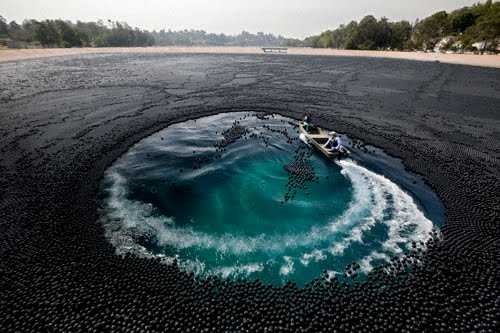
In 2007, high levels of bromate—a carcinogen formed when bromide and chlorine react with sunlight—were found in Los Angeles’s seven-acre, 58-million-gallon Ivanhoe Reservoir. Today, three million black plastic balls help deflect UV rays.

water blessing, conservation, national geographic, sacred water, john stanmeyer, joel sartore, silent streams, paolo pellegrin lynn johnson edward burtynsky, jonas bendiksen, the annenberg apace for photography, art, photography, globally gorgeous, maienza wilson,Art. Annenberg, fresh water, Globally Gorgeous, Maienza-Wilson, National Geographic, photography, Water Sustainability

Lynn Johnson, National Geographic Magazine
Ethiopia, 2009
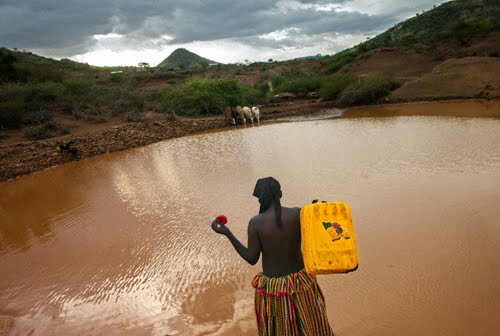
In Shekana, Ethiopia, Halike Berisha must fill her jug from a contaminated reservoir. Access to clean water is not solely a rural problem, but the challenges of delivering it are most daunting in remote places. 

water blessing, conservation, national geographic, sacred water, john stanmeyer, joel sartore, silent streams, paolo pellegrin lynn johnson edward burtynsky, jonas bendiksen, the annenberg apace for photography, art, photography, globally gorgeous, maienza wilson,Art. Annenberg, fresh water, Globally Gorgeous, Maienza-Wilson, National Geographic, photography, Water Sustainability

Theo Allofs, Corbis
Australia, 2006
Brown with sediment loosed by seasonal rains, Australia’s King River snakes through the coastal mudflats of the Kimberley, a remote northwestern region. In the dry months of May to September, the 76-mile meander lies bare.

water blessing, conservation, national geographic, sacred water, john stanmeyer, joel sartore, silent streams, paolo pellegrin lynn johnson edward burtynsky, jonas bendiksen, the annenberg apace for photography, art, photography, globally gorgeous, maienza wilson,Art. Annenberg, fresh water, Globally Gorgeous, Maienza-Wilson, National Geographic, photography, Water Sustainability

Lynn Johnson, National Geographic Magazine
Kenya 2009
Tribal Gabra women in northern Kenya may need five hours a day to lug jerry cans laden with murky water across the desert. A lingering drought has pushed this already arid region to a full-blown water crisis.


The Annenberg Space for Photography is an entirely new cultural destination dedicated to exhibiting compelling photography. The Space conveys a range of human experiences and serves as an expression of the philanthropic work of the Annenberg Foundation and its Trustees. The intimate environment features state-of-the-art, high-definition digital technology as well as traditional prints by some of the world's most renowned and emerging photographers. The exhibits change three times a year, however the common thread throughout is one of rich emotion. The Photography Space informs and inspires the public by connecting photographers, philanthropy and the human experience through powerful imagery and stories. It is the first solely photographic cultural destination in the Los Angeles area.


Related Posts with Thumbnails

"WATER:OUR THIRSTY WORLD" PHOTOGRAPHY EXHIBIT


ShareThis

"WATER: OUR THIRSTY WORLD" ...An Exhibit at the Annenberg Space for Photography in Association with National Geographic Magazine opened Saturday, March 27, 2010.  This exhibition coincides with the release of National Geographic's April 2010 issue on the precarious state of the world's fresh water.  The exhibition will run through June 13, 2010 and examines the local and global challenges of our planet's fresh water resources captured by a selection of National Geographic's finest, award-winning photographers. The digital and print images will highlight the significance of fresh water in our lives and how the diminishment of this precious resource is impacting local and worldwide communities. A digital film presentation will expand the visitor experience by offering hundreds more National Geographic images and shared insights from photographers.


Jonas Bendiksen, Magnum Photos


India, 2009
In a parched Delhi slum, men swarm a tanker to siphon precious water. “If you throw money here,” says a local 16-year-old named Vinay, “no one would have time to grab it. Water is more important for us.”


Amit Dave, Reuters
India, 2003
Parched Indian villagers mob a vast well in Natwargadh, Gujarat. In this drought-prone western state, yearly monsoon rains can total less than eight inches, and summer temperatures have topped 115°F.


Thomas Havisham, Panos


Angola, 2005


Peddling clean well water for 10 cents a bag, this seller will have no problem finding a buyer in a slum in Luanda, Angola. In 2006 the prevalence of contaminated water in the city led to one of Africa’s worst cholera epidemics, with 80,000 Angolans sickened.

Hans Strand, Freelance


Iceland, 2006


Swirling seaward, branches of the bountiful Kolgrima River inscribe the flatlands near Vatnajökull, Iceland’s largest glacier. Milky tones in the water are from pale silt; the blue is the reflection of the sky.

water blessing, conservation, national geographic, sacred water, john stanmeyer, joel sartore, silent streams, paolo pellegrin lynn johnson edward burtynsky, jonas bendiksen, the annenberg apace for photography, art, photography, globally gorgeous, maienza wilson
John Stanmeyer, VII


India, 2009


India’s holiest river, the Ganges, is scribbled with light from floating oil lamps during the Ganga Dussehra festival in Haridwar. Hindus near death often bathe in the river; some are later cremated beside it and have their ashes scattered in its depths.

Edward Burtynsky


California, USA, 2009


Grass is not an option in Salton City, which survives on water imported from the Colorado River. With 20 million more residents expected in California by 2050, the state’s quest for water is never over.

Edward Burtynsky
California, USA, 2009
Once the city’s main water source, the Los Angeles River is now a concrete channel fed by storm drains. City residents rely on water pumped from hundreds of miles away.


John Stanmeyer, VII


Laos, 2009
A woman launches an offering on the Mekong River, known to Laotians as the “mother of waters.” The occasion is Boun Pi Mai Lao, the New Year’s celebration, in April.


Ethiopia 2009
In pursuit of water, the girl with the green ladle routinely walks three hours to and from her Ethiopian village of Foro. Females here spend most of their lives fetching water; boys are exempted from the job when they turn seven or eight. 


Lynn Johnson, National Geographic Magazine


Ethiopia, 2009
To this end, NGOs are working to bring clean water to forgotten places, using technology—like a sand dam to capture rainwater in Ethiopia, where some women must wrest drops from muddy seeps —while ensuring that locals are involved in designing, building, and maintaining water projects." 


Kitra Cahana, National Geographic Magazine


Nevada, USA, 2009
Shaped like a water drop, this 17-foot-tall steel “meditation space” was made by Kate Raudenbush for Nevada’s annual Burning Man event. Her goal is “to bring awareness to the element of water on our planet and its vital importance to our evolutionary balance.”


Lynn Johnson, National Geographic Magazine


Ethiopia, 2009
In the Foro district of Ethiopia, rocks cover a family latrine, and a stick acts as a handle. Surveys show that the hygiene-education efforts of WaterAid, an NGO, are working here: Latrine use has risen from 6 to 25 percent since December 2007.


Lynn Johnson, National Geographic Magazine


Ethiopia, 2009
Installed by the NGO WaterAid, makeshift wash stations like this one—a water bottle fastened to the exterior of a grass hut, with soap nearby—are appearing in Ethiopian villages, where lack of sanitation can be as dire a problem as water scarcity.


Gerd Ludwig, National Geographic Magazine


California, USA, 2009
In 2007, high levels of bromate—a carcinogen formed when bromide and chlorine react with sunlight—were found in Los Angeles’s seven-acre, 58-million-gallon Ivanhoe Reservoir. Today, three million black plastic balls help deflect UV rays.


Lynn Johnson, National Geographic Magazine


Ethiopia, 2009
In Shekana, Ethiopia, Halike Berisha must fill her jug from a contaminated reservoir. Access to clean water is not solely a rural problem, but the challenges of delivering it are most daunting in remote places. 


Theo Allofs, Corbis
Australia, 2006
Brown with sediment loosed by seasonal rains, Australia’s King River snakes through the coastal mudflats of the Kimberley, a remote northwestern region. In the dry months of May to September, the 76-mile meander lies bare.


Lynn Johnson, National Geographic Magazine
Kenya 2009
Tribal Gabra women in northern Kenya may need five hours a day to lug jerry cans laden with murky water across the desert. A lingering drought has pushed this already arid region to a full-blown water crisis. 


About the Annenberg Space for Photography
The Annenberg Space for Photography is an entirely new cultural destination dedicated to exhibiting compelling photography. The Space conveys a range of human experiences and serves as an expression of the philanthropic work of the Annenberg Foundation and its Trustees. The intimate environment features state-of-the-art, high-definition digital technology as well as traditional prints by some of the world's most renowned and emerging photographers. The exhibits change three times a year, however the common thread throughout is one of rich emotion. The Photography Space informs and inspires the public by connecting photographers, philanthropy and the human experience through powerful imagery and stories. It is the first solely photographic cultural destination in the Los Angeles area.


Related Posts with Thumbnails

Tag Clouds

This work is licensed under a Creative Commons License permitting non-commercial sharing with attribution. GLOBALLY GORGEOUS is a trademark of Maienza Wilson in the United States and other countries.Developed by Hari